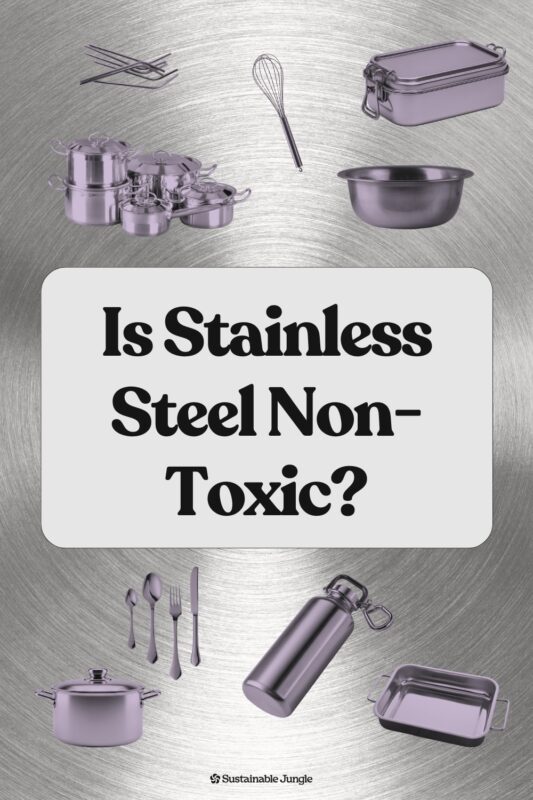










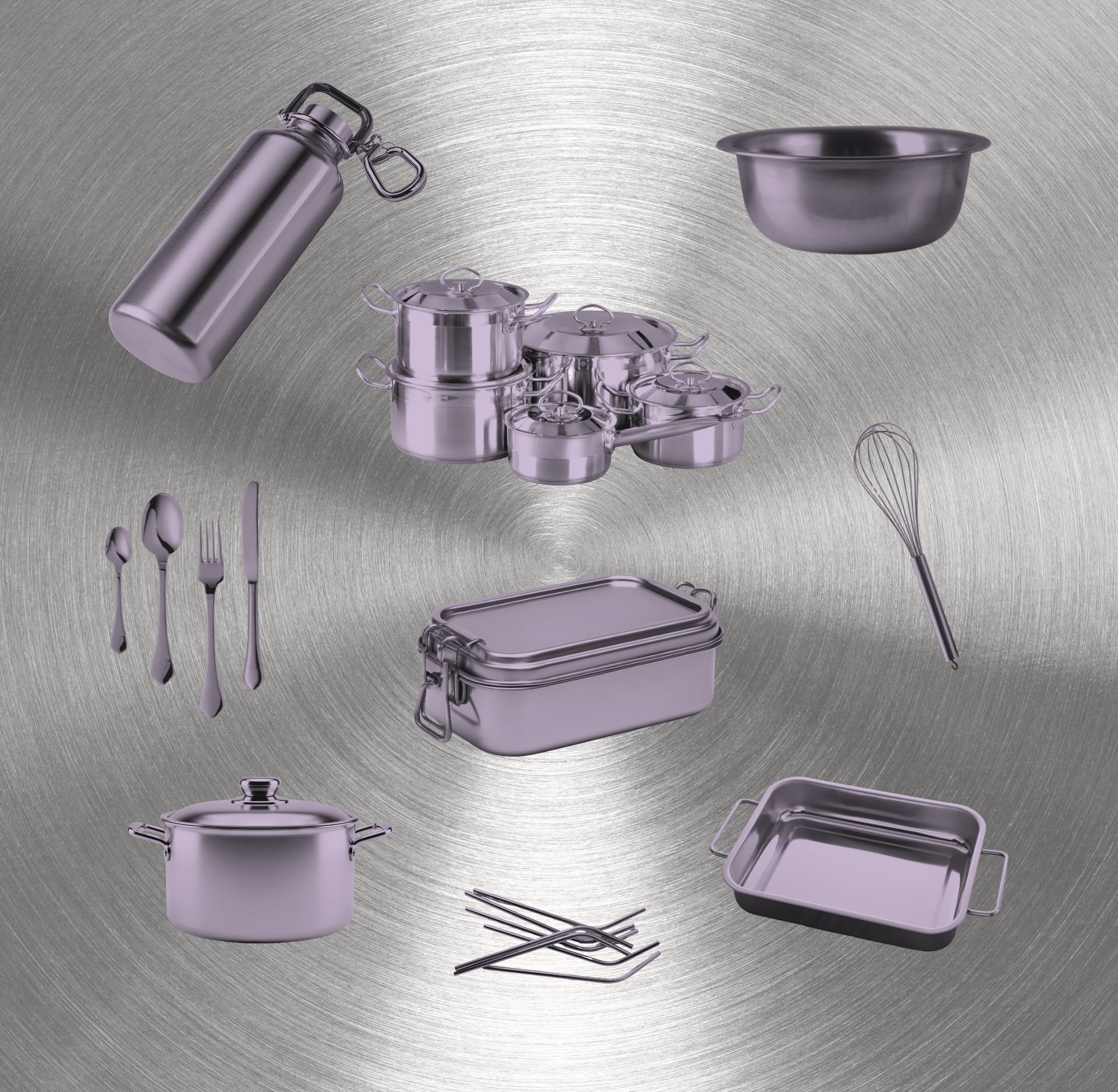
Stainless steel is often thought of as one of the material foundations for a non-toxic and zero waste kitchen. Swap the PFAS-coated nonstick for a good stainless pan, fill a stainless bottle instead of a plastic one, store leftovers in stainless containers instead of Tupperware. You get the idea.
But stainless steel is an alloy and the metals in that alloy (including nickel and chromium) can and do interact with food under certain conditions.
For the majority of us, those interactions fall well within safe limits but for others, particularly people with nickel sensitivity, this can become an issue.
This guide covers what stainless steel is made of, what peer-reviewed research shows about metal leaching, which grades are safest, and how the material stacks up from a sustainability perspective.
So let’s cut through the noise and get to the metal of the matter.
Related Guides: How To Avoid Microplastics?, Non-Toxic & Sustainable Cookware, Non-Toxic Cutting Boards, Non-Toxic Cooking Utensils, Non-Toxic Living Guide, Is Silicone Safe?
At A Glance: Is Stainless Steel Non-Toxic?
- Stainless steel is one of the safest materials for food contact, free of PFAS, BPA, and the chemical coatings found in nonstick cookware. For the majority of people, it is a safe choice for cooking, drinking, and food storage.
- Small amounts of nickel and chromium do leach into food, particularly with acidic dishes and long cooking times.
- For nickel-sensitive individuals, leaching from cookware can contribute to skin flare-ups, making nickel-free grades (430/18/0) or alternative materials like cast iron worth considering.
- Stainless steel is 100% recyclable without quality loss, with high end-of-life recycling rates. Its production is energy-intensive, but its durability and near-total recyclability give it one of the lowest environmental footprints of any kitchen material.
Table of contents: Stainless Steel Safety & Sustainability
- What Is Stainless Steel? Jump to section
- Is Stainless Steel Safe? Jump to section
- Stainless Steel Beyond Cookware Jump to section
- Is Stainless Steel Sustainable? Jump to section
- Comparisons: Stainless Steel Cookware vs. Other Materials Jump to section
- What to Look for When Buying Stainless Steel Jump to section
- Frequently Asked Questions About Stainless Steel Jump to section
What Is Stainless Steel?
Stainless steel is a metal alloy made primarily from iron, with at least 10.5% chromium and varying amounts of nickel, manganese, molybdenum, and other elements mixed in.
The chromium is the key ingredient because it reacts with oxygen to form a thin, invisible protective layer (called a passive oxide layer) on the surface. This layer is what makes the steel “stainless,” i.e. preventing rust and corrosion.
Different combinations of these metals produce different grades of stainless steel, and the grade changes the profile for both safety and durability.
What do the Stainless Steel Numbers Mean?
You’ll often see stainless steel cookware labeled as 18/8 or 18/10. The first number refers to the percentage of chromium, and the second to the percentage of nickel. So 18/10 stainless steel contains 18% chromium and 10% nickel.
These ratios correspond to numbered grade series:
300 Series (the most common for food contact):
Grade 304 (also labeled 18/8 or 18/10) is the standard for quality cookware, food storage, and kitchen equipment. It offers strong corrosion resistance and durability. Grade 316, sometimes called “surgical” or “marine” grade, adds molybdenum for extra resistance to salt and acid corrosion.
400 Series:
Grade 430 (18/0) contains little to no nickel, which makes it the best option for people with nickel sensitivity. The trade-off is that it corrodes more easily. You’ll find 400-series steel in lower-cost utensils, mixing bowls, and some budget cookware.
200 Series:
The 200 series swaps out manganese for nickel to reduce manufacturing cost, but this makes the alloy way less corrosion-resistant. Cheaper imported cookware sometimes uses 200-series steel without disclosing it. Importantly, more corrosion means more metal leaching into food, which makes this grade a poor choice for anything that contacts food regularly.
How Stainless Steel Cookware Is Built
Most quality stainless steel pans aren’t solid stainless steel all the way through. Because stainless steel doesn’t conduct heat particularly well on its own, manufacturers use what they call a clad or tri-ply construction. Which just means layers of stainless steel on the inside and outside with a core of aluminum (or sometimes copper) sandwiched between them.
The aluminum core conducts and distributes heat evenly, while the stainless steel layers provide the non-reactive cooking surface. The aluminum never contacts your food unless the cookware is damaged or worn through, which with a quality pan takes many years of heavy use.
Who Makes Stainless Steel?
China produces roughly half of the world’s stainless steel, followed by India, Japan, South Korea, and the EU.
The raw materials (iron ore, chromium, nickel) are mined across multiple continents, with significant chromium mining in South Africa, Kazakhstan, and Turkey, and nickel mining concentrated in Indonesia, the Philippines, Russia, and New Caledonia.
The supply chain from mine to the finished pan is long:
- Raw ore is smelted into ferrochrome and ferronickel
- These are then combined with iron in electric arc furnaces to produce stainless steel slabs.
- These slabs are rolled, finished, and shipped to manufacturers who form them into cookware, containers, and other consumer products.
The length of the supply chain is a big deal when it comes to its sustainability (or lack thereof).
Is Stainless Steel Safe?
Stainless steel is one of the safest materials for food contact, and it is free of PFAS coatings, plastic linings, and chemical treatments. But there are some nuances worth understanding:
Does Stainless Steel Leach Into Food?
The most widely cited study on this topic, published in the Journal of Agricultural and Food Chemistry by Kamerud et al. (2013), tested multiple grades of stainless steel with tomato sauce (an acidic food) across varying cooking times and repeated use cycles.
After six hours of cooking, nickel and chromium concentrations in tomato sauce increased up to 26-fold and 7-fold respectively, depending on the grade of steel, and longer cooking times increased these numbers.
This sounds alarming at first but it’s worth mentioning that the leaching was highest with brand-new cookware and decreased significantly with repeated use, stabilizing after roughly the sixth cooking cycle as the passive oxide layer became more established. Also, even at the elevated levels, the levels fell within ranges that regulatory agencies consider safe for the general population.
An earlier study by Kuligowski and Halperin (1992) in Archives of Environmental Contamination and Toxicology similarly identified stainless steel cookware as a source of nickel, chromium, and iron in the diet, with leaching increasing when cooking acidic foods for longer periods.
So what increases stainless steel leaching?
Well, acidic foods (tomato sauce, citrus, vinegar-based dishes), long cooking times, brand-new or damaged cookware, and lower-quality steel grades (particularly the 200 series).
But seasoned/well-used cookware, shorter cooking times, non-acidic foods, and higher-quality grades (304 or 316) reduce the potential for leaching.
What About Nickel In Stainless Steel? Is It Safe?
This is relevant in particular for those with nickel sensitivities, which is quite common. According to a review in *Contact Dermatitis* (Ahlström et al., 2019), the prevalence of nickel allergy in the general population runs approximately 8% to 19% in adults, with women affected at 3 to 10 times the rate of men, likely because of higher historical exposure through jewelry and piercings.
For people who are nickel-sensitized, even small oral doses of nickel can trigger dermatitis, which shows up as skin flare-ups that aren’t limited to the point of contact. This means that nickel leaching from cookware into food could contribute to symptoms, even though the amounts are small.
For the majority of people without nickel sensitivity, the nickel that leaches from stainless steel cookware is well below the tolerable daily intake of 13 µg per kilogram of body weight.
To put this in context, and this is an important point, dietary nickel from food itself (chocolate, nuts, legumes, oats, and whole grains are all relatively high in nickel) typically far exceeds what cookware contributes.
If you know you’re nickel-sensitive, it’s worth considering 400-series (18/0) stainless steel, which contains little to no nickel. The alternative is to use cast iron, carbon steel, or glass/ceramic cookware instead.
Is Chromium in Stainless Steel Dangerous?
Chromium is one of the main ingredients in stainless steel, making up at least 10.5% of the alloy. It’s also a substance with a concerning toxicity profile in certain forms.
Chromium exists in two stable forms that behave differently in the body:
Chromium III (trivalent chromium) is the form found naturally in food, soil, and water, and has historically been considered an essential trace nutrient involved in glucose and lipid metabolism, though some recent research disputes its essentiality. It is poorly absorbed by the body (only about 0.5 to 1% of dietary chromium III is absorbed through the gut) and is considered low in toxicity at normal dietary levels, though chronic exposure to high amounts can still cause liver dysfunction and kidney effects.
Chromium VI (hexavalent chromium) is a different story altogether. It is 100 times more toxic than chromium III, is readily absorbed by the body, and is classified as a known human carcinogen by inhalation. Chronic exposure causes serious damage to the lungs, kidneys, liver, and immune system, and it is regulated as a hazardous substance of great public health significance alongside arsenic, cadmium, lead, and mercury. Chromium VI is produced during industrial processes like chrome plating, welding, and leather tanning, and is not found naturally in food or consumer products.
The form that leaches from stainless steel cookware is chromium III. Normal cooking temperatures do not convert chromium III to chromium VI. And as the Kamerud et al. (2013) and Kuligowski and Halperin (1992) studies showed, the amounts of chromium III that leach from stainless steel into food (even under worst-case conditions of acidic food, long cooking times, and new cookware) are small relative to the chromium people consume through their normal diet. The body also has its own mechanisms for processing dietary chromium III, with most of it excreted through urine.
Welding stainless steel does generate chromium VI fumes, which is a well-documented occupational hazard for metalworkers. But that concern is specific to industrial processes, not to cooking with stainless steel in a home kitchen.
Is Stainless Steel Safe When Heated?
Beyond the potential for leaching, under normal cooking conditions (as covered above), yes. The chromium oxide layer that protects the surface is stable at temperatures well above anything you might expose it to in your kitchen.
The exception is severe overheating of an empty pan, which can damage the protective layer and potentially increase metal leaching over time.
If your stainless steel pan is discolored from overheating, it hasn’t become toxic, but you may want to re-season the surface or, if the damage is severe, replace it. Burnt food residue on stainless steel is a cleaning issue and doesn’t make the cookware toxic.
Stainless Steel Beyond Cookware
Stainless steel comes in a lot of different forms. The safety of each depends on what you’re using it for, because the key variables (temperature, acidity, and contact time) will be different.
Stainless Steel Water Bottles
Because water is pH-neutral and sits at room temperature or cold, the conditions that cause leaching from stainless steel (heat, acidity, extended contact) are pretty much non-existent.
Stainless steel water bottles don’t contain BPA, don’t shed microplastics, and don’t degrade the way plastic bottles do. For everyday hydration, stainless steel is about as inert as it gets.
Double-walled vacuum-insulated bottles add an extra layer between the liquid and the outer shell, but even single-walled stainless steel bottles are a solid choice. Look for food-grade 304 (18/8) steel, which is what the most reputable brands use.
Have a read of our guide to plastic-free water bottles if you’d like to learn more.
Stainless Steel Food Storage and Lunch Boxes
No peer-reviewed studies have specifically measured metal leaching from food-grade (304 or 316) stainless steel containers at refrigerator temperatures with typical foods over normal storage periods. However, the existing research consistently shows that leaching increases with higher temperatures, more acidic foods, and longer contact times, so cold storage of non-acidic foods for a day or two would be expected to produce very little leaching.
One study that did test storage at refrigerator temperature (~4°C) used highly acidic lemon juice in cheap 201-grade steel for up to five days and found significant metal migration, particularly for nickel and iron. That’s a worst-case combination (the poorer grade with the most acidic liquid, over a longer storage period), but it does reinforce a few practical points:
- Avoid 200-series stainless steel for food storage.
- Don’t store highly acidic foods (tomato sauce, citrus dressings, vinegar-based marinades) in stainless steel containers for days at a time.
- For overnight leftovers or a packed lunch, the risk is negligible.
The broader advantage of stainless steel for food storage is that unlike plastic containers, it won’t leach BPA or phthalates into your food. Plus it lasts for years and it doesn’t stain or absorb odors.
Our guides to non-toxic food storage containers and eco-friendly lunch boxes cover specific recommendations.
Stainless Steel Cutting Boards
Stainless steel cutting boards are nonporous, which means they don’t absorb bacteria, odors, or moisture the way wood and plastic boards can. They don’t require oiling or conditioning, and they’re easy to sanitize. And they don’t have any chemical coatings, glue layers, or microplastic shedding.
The main trade-off is that stainless steel is hard on knife edges and will dull your blades faster than wood or plastic surfaces. They are, however, a good option if you want to prioritize hygiene and low toxicity over knife maintenance.
We’ve tested a bunch of cutting boards, you can find that testing and our recommendations in our cutting board guide (linked in the introduction above).
Stainless Steel Cooking Utensils
Spoons, spatulas, tongs, and ladles made from stainless steel have very brief contact with food, which makes leaching concerns negligible even when cooking acidic foods. And unlike plastic utensils, they won’t melt, warp, or off-gas at high temperatures.
One thing to keep in mind is that stainless steel utensils can scratch ceramic and enamel cookware surfaces if used aggressively, so we recommend pairing them with uncoated stainless steel, cast iron, and titanium cookware.
For more, see our utensils guide and silicone safety guide (both are linked above in the introduction).
Stainless Steel Straws, Cups, and Other Reusable Products
Stainless steel straws, tumblers, and coffee cups follow the same safety logic as water bottles. They’re also endlessly reusable and, unlike silicone or bamboo alternatives, fully recyclable at end of life.
There are a few brands which make excellent reusable products to keep in mind.
Is Stainless Steel Sustainable?
As with almost all materials, there are numerous tradeoffs to consider when it comes to the sustainability of stainless steel.
The Environmental Cost of Making Stainless Steel
Let’s not beat about the bush! Mining of the inputs for stainless steel (iron ore, chromium, nickel) causes significant environmental disruption and has been linked to deforestation, soil erosion, and water contamination.
After mining, the raw ores are typically smelted and combined in electric arc furnaces at temperatures exceeding 1,500°C. This is super energy and emissions intensive. Given global stainless steel production exceeds 58 million tonnes annually, the aggregate carbon footprint is substantial.
This means that stainless steel is not eco-friendly as far as production goes.
Recyclability and the Circular Economy
Stainless steel is 100% recyclable without any loss of quality, and unlike many other materials, it can be recycled indefinitely. A 100% stainless steel pan recycled today can be recycled (in theory) into a stainless steel product of identical quality.
The recycling rates are pretty good too. According to World Stainless (ISSF), approximately 95% of stainless steel is recovered and recycled at end of life.
A study by researchers at Yale University found that end-of-life recapture rates range from 92% in industrial equipment and building infrastructure to 70% in household appliances.
New stainless steel production already incorporates roughly 60% recycled content on average, because stainless steel scrap has high economic value and there are strong financial incentives to collect and recycle it.
Stainless steel’s end-of-life story is one of the strongest when compared to PFAS-coated nonstick cookware, which cannot be recycled and sheds forever chemicals into waterways. Or to plastic food containers, which can be recycled only a handful of times before the material degrades.
Stainless Steel Durability
The most sustainable product is often the one you don’t need to replace and a well-made stainless steel pan can last 20 to 30 years or more with basic care. By comparison, a nonstick pan typically lasts 2 to 5 years before the coating degrades and the pan needs replacing.
So, over a 30-year period, one stainless steel pan replaces six to fifteen nonstick pans, each of which ends up in landfill instead of being recycled.
When you factor in the production energy, raw materials, shipping, and waste associated with replacing short-lived cookware every few years, stainless steel’s higher upfront environmental cost per unit starts to look very different on a per-year-of-use basis.
Comparisons: Stainless Steel Cookware vs. Other Materials
Stainless Steel vs. PFAS-Coated Nonstick
Toxicity: Unlike traditional nonstick coatings, uncoated stainless steel does not contain PFAS (forever chemicals).
Sustainability: Stainless steel wins on every environmental metric:
- No forever chemicals
- Dramatically longer lifespan
- Fully recyclable
- No contribution to microplastic or chemical pollution
Nonstick pans typically last 2 to 5 years, can’t be recycled, and their coatings break down into persistent pollutants.
Stainless Steel vs. Cast Iron
Toxicity: Both are free of chemical coatings. Cast iron leaches small amounts of dietary iron into food, which is generally considered beneficial (and can be helpful for people with iron deficiency), though people with hemochromatosis should be aware of this. Neither material poses significant toxicity concerns for the general population.
Sustainability: These two materials have a very similar sustainability profile. Cast iron is also highly durable, recyclable, and free of chemical coatings but it’s heavier and requires seasoning.
Stainless Steel vs. Carbon Steel
Toxicity: Like cast iron, carbon steel is uncoated and leaches small amounts of iron. It contains no nickel or chromium, which makes it a good alternative for people with nickel sensitivity. It does require seasoning, and acidic foods can strip the seasoning and impart a metallic taste.
Sustainability: Carbon steel is lighter than cast iron, has very similar durability, and is free of coatings. It requires seasoning and isn’t ideal for acidic foods, but environmentally it’s similar to stainless steel.
For more, read our detailed guide to carbon steel.
Stainless Steel vs. Ceramic
Toxicity: Pure ceramic (not ceramic-coated aluminum) is one of the most inert cookware materials available, with no metal leaching concerns. The caveat is that some ceramic glazes, particularly on older or imported pieces, can contain lead or cadmium, so we’d recommend buying from reputable manufacturers. Ceramic-coated aluminum pans are generally considered safe, but the coating chips over time and exposes the aluminum underneath.
Sustainability: Ceramic cookware has a cleaner production process with lower temperatures and fewer chemical inputs, but it’s more fragile, harder to recycle, and typically has a shorter functional lifespan. Pure ceramic is a good non-toxic option, but stainless steel is far better for longevity and recyclability.
Stainless Steel vs. Glass
Toxicity: Glass is completely chemically inert. Nothing leaches into food or drink at any temperature, making it the safest material from a pure toxicity standpoint. The limitation is practical rather than chemical in that it can break easily in many applications like cooking and for use on the go (in water bottles for example).
Sustainability: Glass is completely recyclable. For storage, it’s excellent. For cookware, it’s limited to bakeware and storage because it can’t handle stovetop use, and it’s fragile. Glass and stainless steel complement each other well if used for applications that meet their particular strengths.
Stainless Steel vs. Plastic
Toxicity: Plastic containers can leach BPA, phthalates, and other endocrine-disrupting chemicals into food, particularly when heated or when storing acidic or fatty foods. Even BPA-free plastics often contain substitute chemicals (like BPS or BPF) with similar concerns. So we would strongly recommend having as little plastic as possible in your kitchen (and in general) and would choose stainless steel every time for cooking and food storage.
Sustainability: Plastic, as you would have guessed, loses on durability, recyclability, chemical safety, and longevity. A big no-no from us on every angle!
Stainless Steel vs. Silicone
Toxicity: Silicone is considered stable at normal cooking temperatures, but some studies have found low levels of siloxane migration at higher temperatures (above 200°C). The long-term health implications of siloxane exposure are not yet well understood. Stainless steel is a far better choice for things like cooking utensils.
Sustainability: Silicone is heat-stable and flexible, but it’s not widely recyclable. Stainless steel is more durable and has a clearer end-of-life path.
For more on silicone, read our detailed guide (linked in the introduction to this article).
What to Look for When Buying Stainless Steel
Here’s our recommendations on choosing better stainless steel cookware, and other products:
- Choose 304 (18/8) or 316 (18/10) grade: These are the standard food-grade stainless steels with good corrosion resistance. If a product doesn’t specify the grade, consider that a red flag, particularly with cheap imported cookware.
- Avoid the 200 series: This lower-cost grade uses manganese instead of nickel and corrodes more easily, which means more metal leaching. Unfortunately, products made with 200-series steel don’t always disclose the grade, so buying from reputable manufacturers is the simplest protection.
- For cookware, look for clad or tri-ply construction: A stainless-aluminum-stainless sandwich gives you better heat distribution while keeping the food-contact surfaces non-reactive. Avoid cookware with an exposed aluminum base, which can corrode and leach.
- If you’re nickel-sensitive, consider 430 (18/0) stainless steel: This grade contains minimal nickel. The trade-off is reduced corrosion resistance, so it requires more careful maintenance. Cast iron, carbon steel, and glass or ceramic are also good alternatives for nickel-sensitive cooks.
- Watch out for “stainless steel” products with nonstick coatings: Some brands market products as “stainless steel” when the base is stainless but the cooking surface has a PTFE or ceramic nonstick coating applied on top. If you’re buying stainless steel, avoid chemical coatings, and check the product description carefully.
- Ask about recycled content where possible: Some manufacturers, like Klean Kanteen and Ocean Bottle, now use mostly 90%+ post-consumer recycled stainless steel. This significantly reduces the emission profile from production.
For brand-specific recommendations, our non-toxic cookware guide (linked in the intro) and non-toxic bakeware guide cover several options we’ve tried.
Frequently Asked Questions About Stainless Steel
Is Stainless Steel Non-Toxic?
For the vast majority of people, yes. Stainless steel is free of PFAS, BPA, phthalates, and the chemical coatings found in nonstick cookware.
Small amounts of nickel and chromium can leach into food, particularly with acidic foods and long cooking times, but the amounts are well below regulatory safety thresholds for most people.
The exception is people with nickel sensitivity, who may want to choose nickel-free grades (430/18/0) or alternative materials.
What Grade of Stainless Steel Is Safest?
Grade 304 (18/8) is the most widely used food-grade stainless steel and is considered safe for everyday cooking, storage, and drinking. Grade 316 (18/10) offers stronger corrosion resistance.
For people with nickel allergies, grade 430 (18/0) eliminates most nickel content but is less corrosion-resistant.
We recommend avoiding 200-series stainless steel, which substitutes manganese for nickel and corrodes more easily.
Is Stainless Steel Dishwasher Safe?
Stainless steel cookware, containers, and utensils can go in the dishwasher. Harsh dishwasher detergents may dull the finish over time, and some manufacturers recommend hand washing to maintain the appearance.
But structurally and functionally, dishwashing doesn’t damage the material.
Is Stainless Steel Oven Safe?
Yes, as long as any handles, lids, or non-metal components are also rated for oven use. Bare stainless steel tolerates temperatures well above typical oven ranges.
We recommend always checking the manufacturer’s temperature rating for the specific product.
Is Stainless Steel Microwave Safe?
Metal cannot go in a microwave because it causes arcing (sparks) and can damage the appliance or start a fire.
This applies to all stainless steel products (and all other metals) regardless of grade or quality.
Can Stainless Steel Be Recycled?
Yes. Stainless steel is 100% recyclable without loss of quality and can be recycled indefinitely.
End-of-life recycling rates are among the highest of any material and happily, new stainless steel production already uses roughly 60% recycled content on average.
Is Stainless Steel Better Than Nonstick?
That’s a resounding yes. Traditional nonstick coatings contain PFAS (forever chemicals) that persist in the environment and have health concerns.
Nonstick pans also have a much shorter lifespan and cannot be recycled.
Whereas stainless steel requires a bit more cooking technique but lasts dramatically longer and avoids chemical coating concerns.
Is Recycled Stainless Steel Safe?
Recycled stainless steel meets the same quality and safety standards as steel produced from virgin raw materials so there is no functional or safety difference.
Stainless steel recycling involves melting scrap at extremely high temperatures (above 1,500°C), which eliminates contaminants.
Final Thoughts On Stainless Steel Safety & Sustainability
Stainless steel’s reputation as one of the most non-toxic and reliable materials is justified.
While the research shows that it does leach small amounts of nickel and chromium into food, particularly with acidic cooking and long cook times, for the vast majority of people these amounts are well within safe limits.
From a sustainability perspective, producing stainless steel from raw materials is energy-intensive and involves mining that damages ecosystems. But the material’s extraordinary durability, near-total recyclability, and high recycling rates mean that its environmental impact is among the lowest of any kitchen material.
One good stainless steel pan, used for decades and then recycled into new steel, is far more sustainable than cycling through disposable nonstick pans (that chip and contaminate your food) every few years.
If you’re building (or upgrading) a non-toxic kitchen, stainless steel cookware paired with cast iron, carbon steel, and glass storage gives you a setup that is free of forever chemicals, built to last, and recyclable at end of life.
So stainless steel gets the steel of approval from us here at Sustainable Jungle. Please share this with any friends or family members who may be interested in purging plastic from their lives.

Lyall studied a Bachelor of Arts in film at AFDA before obtaining a Bachelor of Laws (Honours) at the University of Auckland. Lyall is an Australian based South African who enjoys dedicating his working (and a lot of weekend) hours to promoting social and environmental solutions to everyday issues through online media. As a ‘recovering lawyer’, he finds purpose in building media platforms focused on making sustainability the status quo. When he’s not working with his outstanding team, he’s playing super heroes with his son, reading books or hitting the trails for a run.